Showing posts with label Eurozone. Show all posts

Monday, 12 December 2016

How austerity is crippling schools in southern Europe

While reforms are helping, budget cuts are sabotaging students’ performance
Fifteen-year-olds in southern European countries are struggling to catch up with their peers in international tests in maths, reading and science.
For years, southern European countries have failed to climb up the OECD’s Pisa rankings which assess the performance of 15-year-old students in mathematics, literacy and science.
Greece ranks 43rd out of 72 countries in science, the lowest score among advanced countries, and similar to the levels reported in Chile and Bulgaria. And while Spain and Italy do significantly better then Greece, both scored below the OECD average ranking 29th and 34th in the science assessment.
Two-in-10 Greek students fail to reach the baseline level of proficiency in maths, science or literacy, meaning they are unable to work out the price of an item in a different currency and struggle when reading text to pinpoint its main ideas. Worryingly, the situation has been worsening consistently in the past decade.
Conversely, in Spain, Italy and Portugal, one-in-10 students fail to reach these levels, slightly below the OECD average.
This rift was not always there. In 2006 Greece, Portugal and Italy reported very similar scores, now they differ by more than 40 points — equivalent to more than a year of schooling. Portugal dodged the group of low-performing countries altogether.
What happened to schools in Greece?
The European Commission’s education monitor says the Greek education and training sector was “strongly affected by very low and decreasing public spending, due to strict fiscal consolidation”. Indeed, funding has dropped more than one-third since 2009 and public spending on education is the lowest in the EU.
But funding is not the only problem. Teaching time in Greece is the lowest in OECD countries, about 40 per cent lower than the OECD average. The same EU report also points to “a lack of a culture of performance evaluation” as well as the need for “implementing new decentralisation measures to increase the financial and organisational autonomy of primary and secondary schools across the country”.
Contrary to most European countries, Greek schools are not able to select, pay or fire their schoolteachers, while teachers cannot pick courses, determine the content of the classes they teach or pick their text books. In terms of school autonomy, Greece ranks at the very bottom among 35 OECD countries.
So how did other peripheral countries improve their school systems?
Portugal, Italy and Spain have all introduced reforms aimed at improving the quality of teaching.
In Portugal these included a new funding formula linked to new performance criteria. Italy introduced new school and teacher evaluation systems while Spain’s school reforms — known as LOMCE — introduced a newly designed curriculum, assessments to detect difficulties at an earlier stage and a different approach to the promotion of skills-based teaching and learning.
The European Commission’s education monitor expects school outcomes in all these countries to improve further in the next few years.
Will these reforms suffice?
At this stage it is probably too early to tell, but despite the improvements Spain and Italy still have a wide gap to close and a few issues to tackle.
Both countries are marked by vast regional disparities. The poor regions of Italy and Spain are among the worst performers in the education league. Calabria, in the south of Italy, has a similar proportion of students lacking basic skills as Latin America, while students in Trento, in the wealthy north, perform similarly to their Singaporean peers, the league’s top performers.
Similarly, school outcomes in Madrid or the Extremadura region differ by 54 points in maths, a variation as wide as that between the first and the 23rd best performing countries.
While Portugal’s reformist efforts were coupled with a sizeable chunk of government spending reorientated towards education, Spain, Greece and Italy report some of the lowest shares of education spending in the EU.
Italy’s education system faced some of the most severe cuts — in some cases as high as 20 per cent — despite already being the OECD state with the lowest share of education spending.
To escape what the OECD calls the low-growth trap, peripheral countries need high human capital which can be delivered through efficient and high-quality education systems. Yet education has so far been “a net loser from austerity policies” in these countries”, according to a paper on “The asymmetrical educational consequences of economic recession in Southern Europe”.
The OECD students assessment results released this week gave further proof that peripheral countries must combine reforms with more spending, regardless of their budgetary constrains.

Friday, 25 November 2016

The scale of the European investment crisis and why it matters

Investment in Europe, both public and private, dropped dramatically following the international financial crisis, and in its aftermath growth has been weak in some countries and non-existent in others. The lack of investment growth is particularly worrying in peripheral countries where it hampers the chances of future economic and productivity growth, as well as limiting employment expansion.
Just how steep was the drop?
It’s pretty serious. The Eurozone economy is now about six per cent larger than it was ten years ago, but the real value of investments is still six per cent below its 2006 levels. When compared to the pre-crisis peak in the first quarter of 2008 the drop is even larger, about twelve per cent.
The investment crisis hit the peripheral countries — Greece, Italy, Portugal and Spain — particularly hard. The real value of investments in Portugal, Spain and Italy is about 30 per cent smaller than ten years ago, while that of Greece shrank by 70 per cent.
Were it not for the contraction of investment, the Portuguese economy would have expanded by five per cent in the last ten years instead of contracting; the Italian output would have been flat rather than six per cent smaller and the Greek economy would be 8 per cent, rather than 24 per cent, smaller than ten years ago. And this is without taking into account the multiplying effect of investment on consumption and productivity.
Most peripheral countries are now showing signs of recovery. In Spain, gross fixed capital formation rose by 17 per cent since its lowest point in 2013. In Italy the sector started expanding again in 2014, but only marginally, while in Portugal investment started declining again after a couple of years of recovery. All of them have a long way to go to return to ‘normality’.
The drop is partly due to the collapse of the housing bubble in some of those countries, particularly Spain. And “a swift return to those investment levels would not to be expected or desired” writes a McKinsey report aptly titled “Investing in growth”.
In Greece, investment in dwelling dropped in real terms from €5.3bn ten years ago to just €300m now, a staggering 94 per cent drop. Investment levels in dwellings were halved in Portugal and Spain.
But the drop was not confined to dwellings. Investment in other buildings including factories and schools also fell, as did spending in buying and updating machinery and equipment.
Experts are growing concerned
Economists agree that it matters a great deal, and say it could actually be instrumental to European stability.
The lack of investment growth “is a big concern in terms of demand but also in terms of productivity and potential growth” explains Sebastian Barnes, a senior economist at the OECD and head of its EU desk.
“Low investment reduces aggregate demand, thus lowering short-term growth, and it also hampers medium-term growth through its effect on the capital stock” writeMarco Buti and Philipp Mohl from the Economic and Financial Arm of the European Commission.
“The EU investment crisis means obsolescence of capital, losses in terms of technological advances and potential constraints affecting an effective reallocation of resources” warned a report from the European Investment Bank.
So why is investment not growing?
There is little appetite to invest when demand – both domestic and international — is sluggish, banks are burdened with a heaping pile of bad debts, alternative forms of lending are limited, and uncertainty about the future is high as is the case in peripheral Europe, to varying degrees.
It’s a vicious circle. Until investment growth doesn’t pick up, demand is likely to remain sluggish and the proportion of non-performing loans has little chances of declining. As a result, confidence is unlikely to pick up: “a low growth trap”, as the OECD put it.
The way out? Reforms
In order to escape the low-growth trap and foster investment, governments should work on making their countries more attractive to investors and make investments easier by introducing labour and product-market reforms. This has been repeatedly advocated by both the IMF and the OECD.
These countries did start a process of reforms to improve their competitiveness, including major labour market reforms in Italy and Spain, albeit with little uplift in investments so far. Mr. Barnes encourages governments to do more, particularly in terms of product reforms.
Another major challenge is the financing glut
Stacked with mountainous bad debts, banks can hardly focus on financing new investments. The Capital Market Union, the European project aimed at developing alternative sources of finance firms across the member states, would come in handy at this time. But after the UK voted to leave the EU the project slowed down, to say the least.
Shaking up the status quo
European countries, particularly in the periphery, cut public investment following the financial crisis. As conditions improved, many governments began adopting looser policies, but this barely affected spending in investment. Instead, taxes were cut and administrations focused on encouraging consumption. But, says Barnes, these initiatives won’t do much to promote longer-term growth.
One way public investment could be bolstered is by rethinking the European Union’s fiscal rules and exclude net investment from the spending limit of three per cent of GDP. This is a controversial suggestion, but as they say sometimes stirring the boat is the only way to keep it from sinking.

Friday, 10 June 2016

Brexit and the Capital Markets Union

Brexit and the Capital Markets Union

If the UK were to leave the European Union, it will mean that it will also be outside the Capital Markets Union (CMU), when completed. The CMU is a set of measures designed to clear obstacles between companies and potential investors. The idea – in the words of the European Commission that created it – is “to mobilise capital and channel it to all companies, including SMEs, and infrastructure projects that need it to expand and create jobs”.
The EU economy is slightly bigger than that of the US, but its capital market is very different. Its equity market is about half the size of that of the US and its securitisation market is less than a quarter of the US.
Private finance is 70 per cent higher in the US despite the EU catching up in recent years.
At the moment the UK is an important part of the EU’s capital and financial markets. According to data from the Association for Financial Markets in Europe (AFME), The UK is home to 27 per cent of EU listed companies by market value, 40 per cent of the EU’s listed SME’s are listed on UK exchanges and 46 per cent of the EU’s equity capital is raised through UK capital markets.
But such interconnectivity might not continue if the UK were to be outside the common regulatory framework of the CMU.
Paul McGhee, Director of Strategy at AFME, in an interview with the FT suggests that “a Brexit would call into question the ability of investment banks to offer their services throughout Europe. This would certainly limit the ability of the UK market to act as a hub for raising capital”.
Jean-Pierre Mustier, partner at Tikehau Capital Advisor, stated that “the benefits of the initiatives under the Capital Market Union might only apply to EU countries, which will no doubt launch “charm” offensives to convince firms to relocate.”
While Umberto Marengo, Associate Fellow at the Institute of International Affairs, in a paper published on EUROPP, affirms that “as the undisputed financial centre in Europe, the UK is set to gain disproportionally from deeper capital market integration – if it remains in the EU”.

With a less developed capital market, EU firms have fewer opportunities to access finance and they end up relying on lending from banks. According to S&P Global Market Intelligence only about 10 per cent of US non-financial corporate lending was via banks last year, the proportion is over three times higher in Europe.
European households also rely on the banking sector more heavily then they do in the US. According to data from the Bank of International Settlements more than 50 per cent of the credit to household and non financial companies last year were from banks, compared to about half of that amount in the US. The proportion remained largely stable despite some decline recently.
One of the problem with an large exposure to bank-lending is that it might tighten in times of crisis, as in 2009 when many firms, particularly SMEs, had difficulty accessing finance.
Last year, about one in ten of SMEs in the Eurozone reported access to finance as the most pressing problem they faced, down from about 15 per cent in 2009. The proportion was about double for the micro firms than the large companies and was higher in some countries, including Spain where 27 per cent of SMEs suffered from poor access to finance in 2009.
Moreover, 44 per cent of EU SMEs did not get the full amount they needed and seven per cent had their application refused altogether. The proportion of refusal was much higher in France (13 per cent), Ireland, the Netherlands and Greece, where over 20 per cent of the applications were not fully met in 2015.
Increased investment would be good news for Europe, where the level of fixed capital formation – including buildings, infrastructure and equipment – collapsed after the crisis and are not yet showing signs of recovery, while in the US investment levels are already above pre-crisis levels.
The European Commission estimates that € 1.5-2tn of infrastructure investment will be needed by 2020. Of this, the energy sector is the largest component, with around €400bn on distribution networks and smart grids, another €200bn on transmission networks and storage and €500bn to upgrade and build new generation capacity. But the EC estimates do not cover the whole range of infrastructure. Water & sewage, waste management are not included, nor is social infrastructure or power generation.
Increased and diversified funding resources are expected to revamp economic growth in Europe. While the US has enjoyed a sustained recovery since the Great Recession, economic growth in Europe is weak, with slow productivity growth and pockets of very high unemployment rates.
Smaller countries and countries with less developed capital markets are likely to benefit more from the Capital Markets Union, according to Mr. McGhee , but UK companies will face huge uncertainties if they are out of it.

Saturday, 13 February 2016

The PIIGS drive employment growth in the Eurozone

The PIIGS drive employment growth in the Eurozone

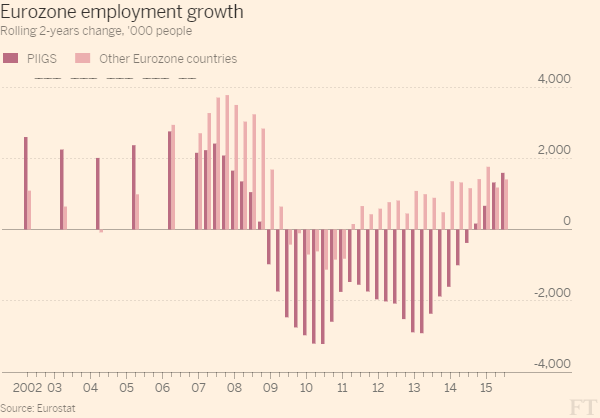
There were nearly 3 million more people in employment in the third quarter of 2015 in the Eurozone than there were two years before. Of these, 1.6 million – over 53% per cent – were from the countries given the acronym ‘PIIGS’, for Portugal, Ireland, Italy, Greece and Spain.
2015 was the first year in which these peripheral countries drove employment growth in ten years. This despite total employment in the PIIGS – about 47 million – being half that of the other Eurozone economies.
Is the revenge of the countries that five years ago were grouped together in a derogatory acronym based on their common lack of growth, high unemployment and high government debt?
Yes and no.
OECD economist Paul Swain, interviewed by the FT, warned that the stronger growth is largely a rebound effect. “the PIIGS countries have been (and still are) in the process of absorbing the very high levels of labour market slack that had built up, whereas most other Euro area countries have moved beyond that phase of the business cycle”.
In the two years to the end of 2009 the PIIGS lost over 2.7 million jobs- about 5.3 per cent – compared to only 174,000 jobs in the rest of the Eurozone. In the PIIGS the decline continued for six years and reached the low point as recently as the first quarter of 2014 with a total loss of 12 per cent of the workforce.
By comparison, in the rest of the Eurozone employment shrank for less than three years and wiped out comparatively few jobs – 3 per cent from the peak in the third quarter of 2008 to the start of 2011. The recovery of the PIIGS is not yet complete and employment levels remain well below pre-crisis levels.
But the current fast employment growth is not only due to the low levels reached during the crisis. “Employment growth in the past two years almost certainly was strengthened by recent reforms in some or all of the PIIGS” adds Mark Keese Head of the Employment Analysis at the OECD, particularly in Spain where the government has enacted “measures to render wage setting more responsive to labour market conditions” and in Greece where wage levels have been reduced.
As a result, cost competitiveness increased in all PIIGS countries, except Italy.
Spain on its own added more than 800,000 jobs in the two years to Q3 2015 compared to 560,000 s in Germany, despite the Spainish labour force being half the size of Germany’s. And the data released on Thursday shows that the pace of Spanish employment recovery accelerated in the final quarter of last year.
Moreover, Spain is also creating jobs among those of core working age (25-55), while in most other Eurozone countries the recovery is concentrated among the over-55s. As a result, Spain accounts for 600,000 – around 30 per cent – of the 2 million jobs created among the 25-55 years age group in the last two years in the Eurozone. Spain is the largest contributor to this growth, despite being only the fourth largest economy.
Employment growth in peripheral countries- particularly in Spain and Ireland- has helped the recovery of household demand, with Spanish expenditure on household durable goods growing at an annual rate of 14 per cent in Q3 2015, compared to four per cent in Germany.
“It is to be hoped that rapid employment growth will continue for some time in the PIIGS countries” says Paul Swain, peripheral economies and sluggish Eurozone growth need it.

Thursday, 7 January 2016

The New World of Work: A changing landscape


August 4, 2015 11:06 am

The New World of Work: A changing landscape

More than eight years after the international financial crisis, many new jobs have been created.
But unemployment rates still remain well above pre-crisis levels.
As Europe’s post-crisis workers live through huge labour market upheaval, FT reporters look at what this means for young people, businesses and economies.
The jobs market has started to recover and unemployment rates are now declining. However, in the euro area, the unemployment rate is still 3 percentage points higher than it was in 2007. The unemployment rate in the OECD as a whole is falling faster, but has yet to reach pre-crisis levels.
Unemployment rates remain stubbornly high, particularly among peripheral European countries. In Spain and Greece it remains above 20 per cent.
While unemployment rates have declined, the proportion of people in non-standard employment has increased since 2005, according to the OECD. Non-standard jobs includes part-time and short-term workers and self-employed people.
About two in five people in employment have such contracts in Spain, Italy and Germany. Across the OECD, an average of one in three jobs are non-standard.
Temporary jobs account for more than 20 per cent of employment in Spain and an average of 11 per cent of jobs in the OECD. These kinds of jobs tend to be much more widespread among young people. More than half of those in work and aged between 15 to 24 years old in 2014 in Spain, France, Italy and Germany were in temporary employment.
France and Italy have registered some of the biggest increases in the proportion of short-term workers over the past 10 years. In Italy the rise has been particularly concentrated among the youth.
A temporary job might be a first step in the workforce, but could prove to be a trap. According to the OECD less than 50 per cent of workers in European countries in temporary jobs had full time permanent contracts three years later.
Poverty rates are much higher among people with non-standard jobs than among full-time permanent employees across all OECD countries. About 22 per cent of households that rely on non-standard work are below the poverty line.

Older workers lead employment growth in the Eurozone (lots of charts)

Older workers lead employment growth in the Eurozone (lots of charts)

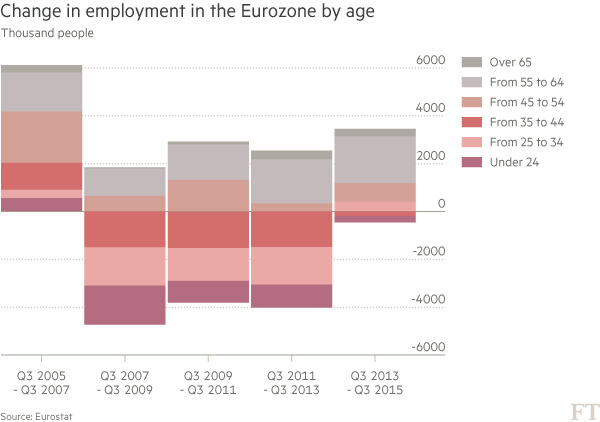
Employment is growing in the Eurozone. There were nearly 3 million more people in employment in the third quarter of 2015 than there were two years before.
However, of that 3 million around 2.3 million – or 75 per cent – were aged over 55, while the number of people in employment younger than 45 has continued to decrease.
The stronger employment performance of older workers is not new. Over the period of the crisis, jobs were lost among all age groups up to 45 years, but employment never stopped rising among the older population.
Italy lost about 1 million jobs – 5 per cent – from its employment peak in April 2008 to the trough in September 2013. Since then Italy has gained more than 400,000 jobs overall, but the number of people employed under the age of 55 has continued to decline.
In France employment expanded throughout the period analysed except for the two years to Q3 2009, but the growth was largely driven by older workers. In the two years to Q3 2015 employment for people aged under 45 expanded for the first time, but older workers still accounted for about two thirds of the net gain.
In Germany overall employment has been expanding since the start of 2010, but in contrast to France the number of people employed under the age of 45 never stopped falling. The 35 to 44 age group were hit particularly badly over the crisis and have yet to show any sign of recovery.
Spanish employment trends are different from those of the other major Eurozone countries. The employment contraction in Spain was massive. Nearly 3.8 million jobs – about 18 per cent of the workforce – were lost from August 2007 to February 2013. Younger workers were hit hardest, but there was also no growth in the employment of older workers. Since then employment has been expanding across nearly all age groups.
As with Spain, employment growth in the UK has not been concentrated among older workers. The employment performance of the group aged 45 to 55 showed an even stronger performance than the over 55 groups during and after the crisis. Those aged less than 35 were the ones hit more strongly by the crisis, but employment of these groups have grown faster since then. In the two years to Q3 2015 under-35s accounted for nearly half of all net employment growth.
But why have older workers led the employment recovery in the major Eurozone countries?
Structural reforms to pension and benefit system are an important part of the story. The trend could continue in France and Italy where, despite strong employment growth, fewer than 50 per cent of the population aged 55 to 64 were in the labour force in 2014, compared to 63 per cent in the UK.
Moreover, according to an ECB economic bulletin the strong employment trend among older people “may also reflect increased financial needs following losses in household wealth or income as a result of the financial crisis.”
Demographic effects – as the population ages – have had a larger effect in Germany where employment for the 35-44 age group contracted in terms of the number of jobs but remained fairly stable as a share of the population in that age group. However, both the absolute number of older workers and the proportion of the age group in employment have increased strongly since 2005.

But in France and more markedly in Italy the loss of jobs among younger employees and the lack of recovery have been even stronger trends than the changing demographic structure, and labour force participation rates have dropped among younger age groups over the last ten years.
High minimum wages and dual employment protection policies have beenmentioned as explanations for the lack of job opportunities for young people in both countries. In Italy, a poor vocational training system, high temporary contracts that lead to a lot of ‘churning’ and poor training of workers under fixed-term contracts all contribute to the poor employment performance among the youth.
The expansion of total employment in the Eurozone is good news, but the process now needs to involve young workers and those of prime working age.