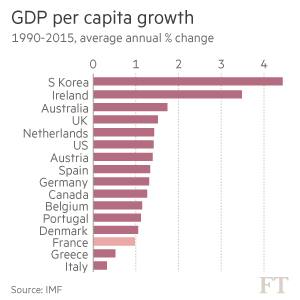
Lack of structural economic growth has contributed to political disillusionment in France. The average growth in French GDP per capita since the 1990 was the lowest among any other major European country except Italy and Greece.
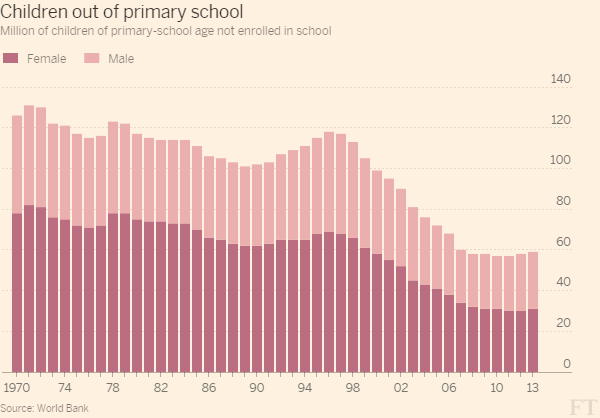
The number of children of primary school age not enrolled in school has halved since the 1970s to about 60 m. The fall was fastest among girls who made up for about two third of the number in the 1980s to just over half of the children in the latest data. Most of the children are in Sub-Saharan Africa.
However, progress has stalled. While access to education expanded considerably at the beginning of the 2000s, there has been little or no change in the global number of out-of-school children since 2007. The global primary out-of-school rate has stagnated at around 9% for the past seven years.
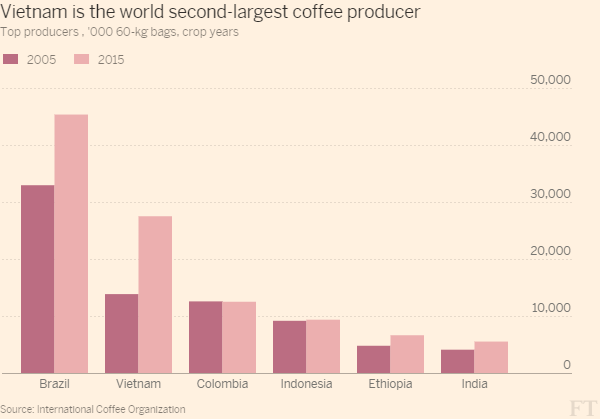
Coffee production in Vietnam doubled in the last 10 years making the country the world’s second-largest producer after Brazil. With over 27 million 60-kg bags produced annually, Vietnam accounts for 20 per cent of world coffee output, up from 5 per cent just twenty years ago.
Vietnam specialises in Robusta coffee, of which the country is the world’s leading producer. Brazilian output of Robusta – second largest – is only about half that of Vietnam. Indonesia was the leading Robusta producer in the 1990s, but it is now a minor player compared with Vietnam.
Brazil dominates the softer Arabica coffee market, responsible for 44 per cent of global production. With 38 million bags produced yearly, Brazil has no real competitor. Its production is about three times higher than that of the second producer – Colombia- and has grown nearly 50 per cent in the last 10 years.
Italy, the US and Germany are the main coffee export markets for both Brazil and Vietnam, but the latter has also a significant presence in China – its fifth largest market. Coffee consumption in China is still small, tea being preferred to coffee, but it’s rising. The potential for Vietnamese coffee production are huge.
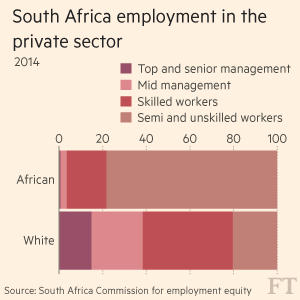
Nearly eight in 10 African employees in the private sector in South Africa are unskilled or semi-skilled workers. Only a few have top or senior management positions. By contrast, two in five white employees are in top, senior or middle-management positions.
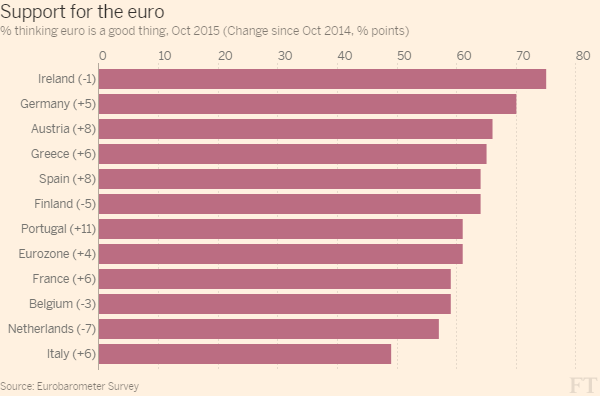
The share of the Eurozone population reporting that the single currency is a good thing stood at 61 per cent in the latest annual survey from Eurobarometer, up 4 percentage points from the previous year, and compared with 45 per cent in 2007. This is the highest level since Eurobarometer started tracking support in 2002.
The largest increase in popularity was in Portugal where support rose by 11 percentage points, but a strong uplift was also registered in Austria, Greece, Spain and France.
In contrast in Finland, where the economy is still struggling to recover, the support for the euro dropped.
Despite this general rise in popularity, fewer than half of Italians have a favourable view of the euro, the lowest proportion across all Eurozone countries.
The report also shows that men (66%) have a more favourable opinion than women (57%) and young people (71%, aged 15-24 years old) more than older age brackets (59-61%).
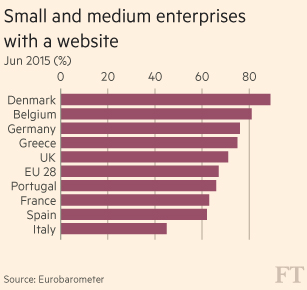
About two in three small and medium-sized enterprises in the EU have a website presenting their products and/or services according to a Eurobarometer survey of more than 14,000 companies. The share is higher in Northern Europe with nearly 9 in 10 companies having that facility in Denmark.
In Italy less then half of the companies have a website, the lowest proportion in the European Union.
The report also investigates the level of openness to external markets and it shows that one in three SMEs in the European Union exported to another country in the three years preceding the survey and a slightly larger proportion imported from abroad.
Denmark and Germany report higher levels of internationalisation, while less then one in four SMEs sell their products and services abroad in the UK, France and Italy.
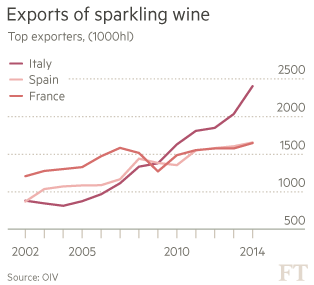
With the success of Prosecco, Italy is now the world leader in exports of sparkling wine, with export volumes nearly 50 per cent higher than from Spain and France. Italy surpassed France in 2009 and Spain the following year.
The US dominates the export of royalties and fees, the charges for the use of proprietary rights (such as trademarks and copyrights). The UK was the second-largest exporter in the 1990s, but fell to sixth by 2013. China only accounts for 0.3% of the global total.
Participation in the labour force in G7 countries has risen among those aged 55 and over but fallen for younger people since the start of the financial crisis. For those in their thirties, participation has fallen for men and risen for women.
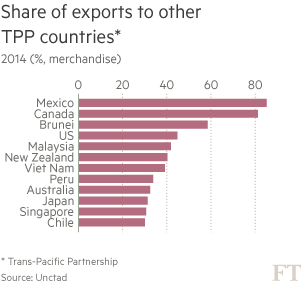
About half of the merchandise exports of the 12 Trans-Pacific Partnership go to other TTP countries. The share is higher for Mexico and Canada because of their strong trade links with the US, but it is below one-third for Australia, Japan, Singapore and Chile.
Six of the 189 economies for which the IMF produces forecasts are now expected to contract in 2016. Only a few months ago, four were set to expand next year. Venezuela and Belarus are